Sorry for the lack of updates over the last few weeks or so... it's been pretty manic on here lately with plenty to record and organise; for the island, its definitely the busiest time of the year.And with such fine weather dominating things for a change, I've been out most days with the camera.So hence this massive blog with heaps to talk about, and illustrated with heaps of photos too...here we go, take a deep breath!
The end of April saw a dusting of redwings around the island, including a single in Kinloch (a singing male) from the 20th to the 23rd.In fact, we may even get a breeding record this year, as a pair are still knocking around the village (last seen on May 10th). A pair of linnets have been seen regularly in Kinloch since early April also, so there must be a favourable chance of a breeding record this season too.The first grasshopper warbler of the year was reeling around Lea Cottage on Saturday 21st April, with one also holding territory in the walled garden since about the 23rd.Another has been heard along the upper road between the start of the Dibidil track and Bay View on several occasions up to May 10th.
Harris had the first cuckoo of the year on the 23rd April, but has also played host to quite a large flock of golden plover up on the raised beach area this spring, with 23 being counted on April 24th. Presumably these are migrants stopping off on their way north, or perhaps a second batch of breeders waiting their chance in Rum's ploverly gene pool.
 |
| Two of our golden plovers |
 |
| Twenty three of our golden plovers |
Short-eared owl must be breeding again this spring, as they keep cropping up at various places around the island.One was reported from Glen Shellesder on the 23rd April along with a single bird at Harris on the 3rd of May. 8 snow buntings and 2 juvenile dippers were reported from Hallival on the 23rd April, and a single great northern diver and a lone cormorant (annual but still a rare occurrence on the island) were both in Loch Scresort on the 25th April, and 7 red-throated divers were noisily displaying on the 27th April. The 27th also saw the first of this seasons blackcaps returning, with several males now singing in the village. A pair of common buzzards have been seen on various occasions over the village and seem to be holding territory out in the North of the island.
 |
| Flying high in blue sky over the Community Hall...a common buzzard |
Despite the fact that otters are quite secretive at this time of year, several have still been spotted around the island, with reports of singles at Cave's Bay on the 29th April & 19th May, Kilmory on May 4th, and a very nice male observed at Rubha na Roinne on the 13th May.
An awesome male ring ouzel at Harris on the 28th April was a welcome surprise. This species is very much like a blackbird, but has a white crescent on its breast (see picture below).It is a scarce breeder on Rum that usually frequents higher areas of the island where it will nest in all probably.This individual was apparently just in from its wintering grounds around the Mediterranean and North Africa, as I initially spotted it in the tree plot. We're not entirely sure how many breed on the island, but there's a couple of pairs at least...a future project for me perhaps, but both the words needle and haystack immediately spring to mind? Sadly the species has declined so much since the 1970's, that it is now included on the UK 'Red List', so definitely a worthwhile project.
 |
Adult male ring ouzel, Harris.
Unlike its close relative the blackbird, ring ouzels are usually wary and wild,
so I couldn't get a closer photo. |
The cuckoos have arrived from their wintering grounds in equatorial Africa (so it must be summer), and many have been very obvious at various places around the island.They're usually shy, but not at this time of year; this pair at Harris were displaying and frolicking about all over the Harris tree plot on the 28th April. Lots of most excellent acrobatics with the male chasing the female or vice verca!The male was giving off the species infamous call, but the female gives off a rapid bubbling which always reminds me of a small monkey. Its weird anyway, and not very bird-like.
 |
| Acrobatic cuckoo action |
 |
| Frolicking cuckoo action |
As I'm talking cuckoo....the cuckoo flower is in full petal out around Kinloch Glen and village environs at the moment.This is a pretty springtime flower and is called the cuckooo flower because it blooms for the most part in April and May, when the cuckoo begins to call.
 |
| Cuckoo flower Cardamine pratensis |
As the end of April and early May has been awesome weather wise, I finally took the opportunity to use my spring traps for the first time this season, and have been catching and ringing plenty of wheatears down at Harris (under BTO licence of course).The birds pictured below are males as they have the classic highwayman's mask.You can see this species throughout much of the island in the summer months, but as there's plenty of short grass both at Harris and Kilmory, these areas are especially good.In fact, it's quite rare to see them around Kinloch village, so the four that turned up on the shore near Ivy Cottage after the gales on May 14th were a welcome village change.
 |
| Male wheatear |
 |
| Male wheater, Harris 29th April |
Mid May is without doubt the best time of the year to observe skua passage around the west coast of Scotland, so as May 13th was forecast to have gale force south westerlies with rain, I decided to get out to Rubha na Roinne on Rum's east coast for a five hour seawatch, and try to see what was passing through. Despite finding a great bit of shelter, I got pretty wet and didn't really see anything of note, as there was little moving.BUT you have to try these things as undoubtedly birds will be blown into our inshore waters.If only we had had some of the magic 417 long-tailed skuas or a trickle of the 172 pomerine skuas reported off North Uist that day....I'm forever the eternal optimist and we will one spring!!
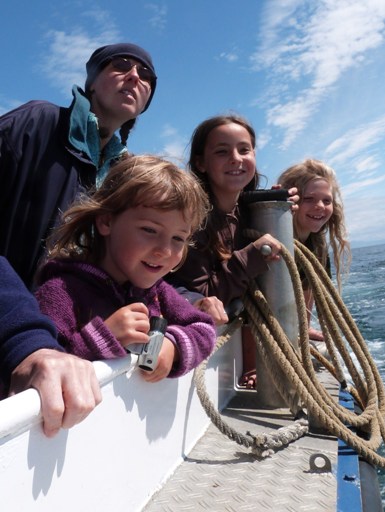
As the MV Sheerwater is now sailing regularly from Arisaig on the summer timetable, the usual Thursday Ranger led boat trip to Soay is now being advertised to our visiting public (check out the website).The first trip on the May 3rd wasn't disappointing, as we had plenty of close manx shearwatters, two nice bonxies, 2 red-throated divers, kittiwakes and gannets galore (see pics below).
I haven't personally spotted any cetaceans yet on the trip (which is now into its third week), but things are picking up on the marine front with a scattering of minke whales (2 in the outer Loch Scresort area, 1 off Sleat, 1 off Eigg) and 100 + short-beaked common dolphins have been observed around The Small Isles from May 1st. Basking sharks are also back on the menu so to speak, and a bumper season has been predicted by the scientific community (would be great to know how they work this out eh).Sean spotted one off the east of Rum on the May 3rd and up to five have been seen around Tiree on May 8th, so they're on their way.We should now start to see many around the coast as we get into June. Oh and before I forget, also 12+ harbour porpoise inbetween Arisaig and Eigg on May 8th.
 |
| THE MV Sheerwater..the first of many wildlife watching trips to Soay |
 |
| Soay bound on the Sheerwater... |
 |
The great skua or bonxie as its now commonly known, is the old Norse word for the species.
This literally translates as the bully of the sea, because like all skua species, the bonxie attacks other birds (usually gannets) for their food. Even the big gulls get twitchy when these guys are lurking about! |
 |
| Bonxietastic views! Our usual pair at Kilmory are now on territory..beware! |
 |
| Adult gannet |
 |
| Rum's favourite species |
Talking of our old favourites, an exciting and very valuable time was had by students on the Ecology and Field Studies course from the University of Edinburgh, when we undertook a night time shearwater colony expedition up to Hallival on the 30th April. Professor Pete (Higgins) has been taking students from all over the world up to the sub-colony for many years, but doesn't usually go via the shearwater research hut and the North East face, so my rangering services were appreciated.As the island lends itself so well to outdoor learning experiences such as this, we should really be organising more of this kind of thing in the future, i.e.adventure education.All aspects worked well, as noise and light disturbance was managed effectively.A trial run perhaps...watch this space.
 |
Up at the colony.
Environmental learning outdoors at its very best |
I'm just going with the flow here, so apologies for jumping from one subject to another!
Now plants!
Everything is growing so fast and I cant keep up with it, but here are some of the best of the last few weeks......
 |
| Common milkwort Polygala vulgaris |
 |
| Marsh marigold Caltha palustris |
 |
| Common cottongrass Eriophorum angustifolium |
 |
| Wood sorrel Oxalis acetosella |
 |
| The blue bell wood |
Other recent wildlife includes a single collard dove (at Tattie House) and a sand martin in the castle fields both on May 10th, and a single adult summer great northern diver seen on May 10th and 15th in Loch Scresort.Both sedge warbler and whitethroat turned up last week from the 14th at least. The first 'commic' tern of the year was on May 6th off Arisaig, and at last one confirmed arctic tern in loch scresort yesterday (May19th). Good news on our breeding hen harriers with conformation of a breeding pair at the usual place (they've got five eggs this season).Swallows are back at full strength with birds using the Byre Building and more recently at the Visitor Centre from May10th at least (lots of swallow droppings very evident from that date...defo going to have to get that mop and bucket out again this summer) and two whimbrel off Rubha na Roinne on May 17th heading north.
Over the last few weeks or so most of our red deer have been casting (or dropping) their antlers (well the males that is) and I've noticed many visitors leaving the island with an antler souvenir attached to their backpacks.If they're found in either Glen Shellesder or Kilmory, the Kilmory Deer Project are asking that you hand them in so that important information can be gained.
Researcher Martyn Baker will be very busy down at Kilmory over the next few weeks, as this is the peak calving period when many hinds will be literally dropping their little bundles of munching joy into the long grass or heather.The calving team that will be wrestling these new borns will be at full strength next week, when even more volunteer deer catchers and spotters arrive.
 |
Red deer..single sex groups at the moment.
The stags pictured here at Harris are dropping antlers, whilst the hinds are dropping young! |
We've had the usual run of visiting ships and cruise liners of late with the Stockholm, Polar Quest and Ocean Nova popping in for visits (the Stockholm being in 3 times this spring already).The Ocean Nova i.e., Excursions Ltd, booked my services for a guided walk up Kinloch Glen (for 22!) on May 15th. Great stuff, but how can we persuade more passengers to step away from the castle for once?
 |
| The Stockholm |
 |
| The Polar Quest |
 |
| The Ocean Nova |
And Rumics (the folk of Rum) celebrated 3 years of community ownership on Friday 11th May with a ceilidh, BBQ and much swaying, some more than others anyway.Neil, I must get a pair of those magnetic boots you wear, they keep you amazingly vertical.
 |
| Happy Rumics at the ceilidh |
Apart from the odd day, the weather and the light has been absolutely awesome lately, so as usual, some recent weather and landscapes from the island in pictures (there's quite a few sorry, but it's been so nice!).
 |
| Bagh na h-Uamha |
 |
| A mid afternoon moon...could be anywhere, but it is Rum. |
 |
| Cave's Bay or Bagh na h-Uamha...so much better without a fish farm! |
 |
| Just like the Mediterranean...Coll from Harris. |
 |
| Evening views out east....Loch Scresort |
 |
| The tree plot of migrant dreams (Harris). |
 |
| The pre-clearance village, Harris |
 |
| Harris beach |
 |
| Front road evening sun |
 |
| Cooling off...afternoon evaporation on Hallival |
 |
Smokin! Morning helm cloud on Hallival.
I sometimes wonder whether I'm becoming a bit of a Richard Dreyfuss from Close Encounters (of the Third Kind) , ie a wee bit obsessive over a mountain and its shape.There is something very satisfying about Hallival however, but I haven't resorted to making mash potato models out of my dinner or huge clay ones in the living room.
Well not yet anyway...there's plenty of time to go completely bonkers in the winter. |
 |
| REDRUM! |
 |
| Another satisfying shape....Eigg from Loch Scresort |



.JPG)